What a missed call costs
About half of the people who call a home-service business reach a person, and most of the rest do not leave a message.
Those are two measured facts, not a sales line. Invoca’s July 2026 benchmark, built from calls its customers track, puts the share of callers to home-service businesses who speak with a person at 52%, or 65% once calls under 15 seconds are dropped, with sub-industries ranging from 32% to 74%. [1] CallRail’s September 2025 survey of 1,000 US consumers asked what people do when nobody answers: 42% say they leave a voicemail, 21% say they immediately call another business, and 82% say they will call a competitor if the business does not answer. [2]
| What the surveys say | Figure | Who said it |
|---|---|---|
| Callers to home-service businesses who reach a person | 52% | Invoca, July 2026, averages across its customers. For calls longer than 15 seconds, which drops misdials, 65%. By sub-industry, 32% to 74%. [1] |
| Consumers who leave a voicemail when nobody answers | 42% | CallRail survey of 1,000 US consumers, September 2025; what people say they do. [2] |
| Consumers who immediately call another business | 21% | Same survey. [2] |
| Consumers who say they will call a competitor if the business does not answer | 82% | Same survey. [2] |
| Consumers who have dropped a business after an unanswered call | 78% | Same survey. [2] |
| Consumers who hang up after one to two minutes on hold | 41% | Same survey. [2] |
Both sources have limits worth stating to a prospect. Invoca’s customers are businesses that already track their calls, which single-truck shops mostly do not. CallRail’s figures are what consumers say they would do, across every kind of business. Neither measures the business you are pitching. The audit below does.
Who to sell to first
Home-service trades where nobody is free to answer the phone: roofing, HVAC, plumbing, electrical, painting, landscaping, pest control, cleaning. The patterns to look for, as screening criteria rather than evidence:
- Single-truck operations. The owner is on a job most of the day and the listed number is a mobile.
- After-hours calls. Evenings, weekends and emergency calls, where the posted hours end before the calls do.
- Seasonal peaks. HVAC in summer and winter, roofing after storms, landscaping in spring.
Google’s own ad products treat calls as the lead for these trades: on Local Services Ads, home-service businesses pay per valid lead, and Google names phone calls as a lead type. [9] A business paying per call and missing half of them is the clearest prospect.
How to find them
Search one city and one trade at a time in Prospects. Each result has the business’s website, review count, Google Business Profile link and a check of its website. Filter on:
- No website, or a website with no way to book or request a quote.
- A low review count.
- No business hours on the Google Business Profile.
None of those proves a business misses calls. They narrow the list to businesses with nobody minding the front desk online, which is who you then call. See Results, filters, and exports.
The owner cannot see missed calls on their own profile. Google removed call history from Business Profile on July 31, 2024. [3] What remains is a count of taps on the call button, which does not say whether the call was answered. [4] That is the gap your audit fills.
The missed-call audit, done honestly
Call each business during its posted hours, as a customer would. Write down what happened:
- Whether someone answered.
- How many rings before voicemail or a disconnect.
- Whether the voicemail box was set up or full.
- Whether anyone called back, and when.
Use only calls you made, with the date and time of each. Do not record the call: federal law needs one party’s consent, and some states, Florida and California among them, need every party’s. [5] Do not estimate or invent call volumes, lost revenue or missed-call rates. If you did not call, leave the audit out of the pitch.
Build the demo before the pitch
Build the business a preview site with two paths for a customer: a call button and a Get an estimate form.
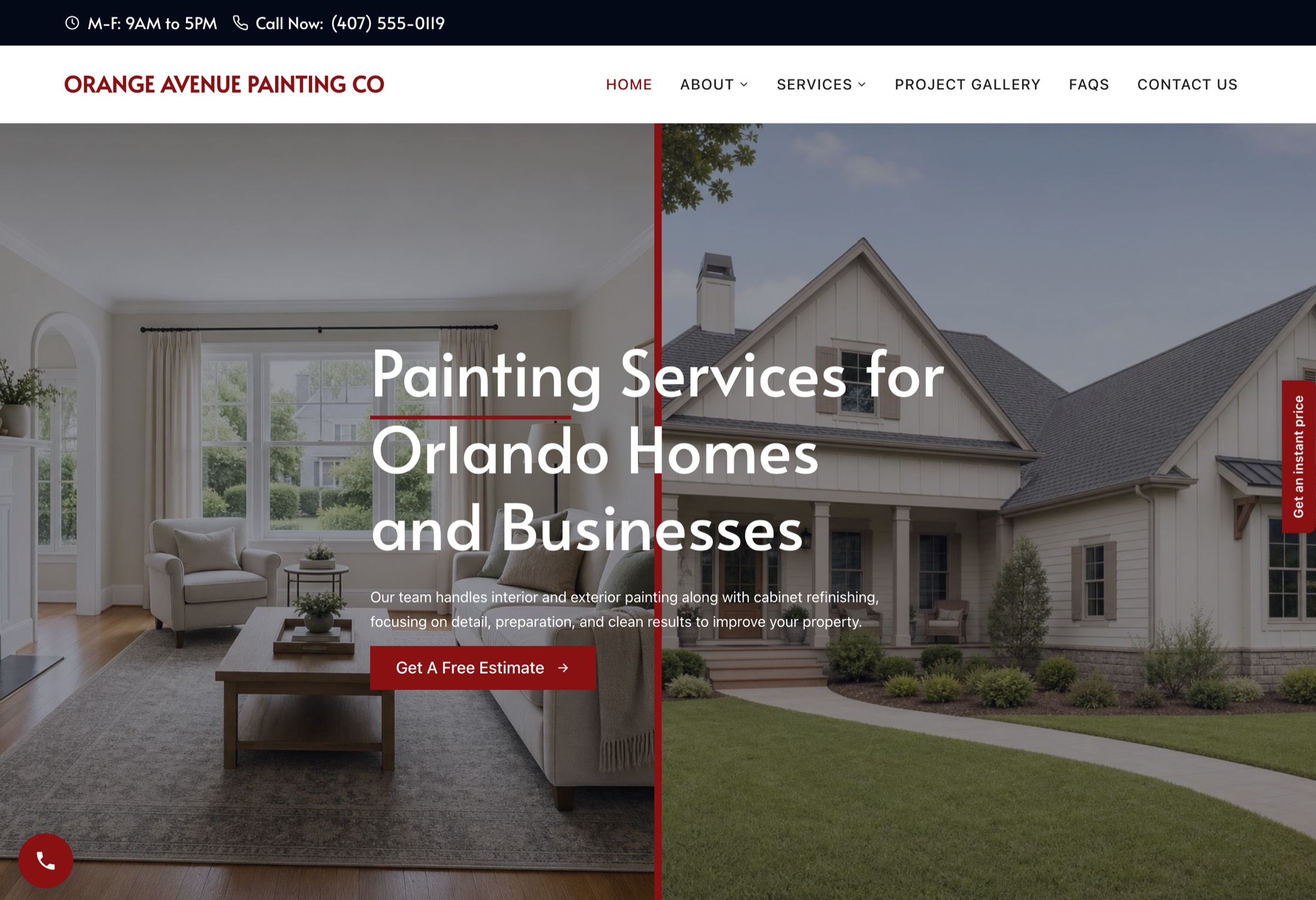
The AI receptionist plugs in at the phone number. Take a number from the tool you choose, put it on the preview site, and set the greeting to the business’s name and services. The prospect can call the demo and hear it answer. When they say yes, the business forwards its real number to the receptionist, or puts the receptionist number on the site and the profile.
Outreach sequence
Three emails, day 0, day 3 and day 7, all in one thread. Leave out the first sentence of email 1 if you did not make an audit call.
Subject: calls to [business name]

Hi [first name],

I called [business name] on [day] at [time] and reached [voicemail / no answer].

I built a demo site for [business name] where an AI receptionist answers the phone: [preview link]

Should I send the details?Hi [first name],
Following up on the demo for [business name]: [preview link]. You can call the number on it to hear the receptionist. Should I send the details?Hi [first name],
Last note from me on this. The demo stays up until [expiry date]. Reply if you want it.Every email carries your business name, a mailing address and a line that says how to opt out. Emails 2 and 3 go as replies in the same thread.
What the tools cost
Six AI receptionist tools and what their own pricing pages said on October 5, 2026. Prices change; check the page before you quote. The feature every one of them describes is answering and transferring calls; most also list call summaries by email or text and appointment booking.
| Tool | Entry plan, as listed | Usage pricing, as listed | Agency or white-label, as listed |
|---|---|---|---|
| Smith.ai [10] | Free plan with 25 calls a month; Pro $150 a month; Enterprise $500 a month | $3.00 a call after the free 25; $2.00 a call on Pro; $1.67 on Enterprise | Reseller and wholesale programs; no price shown |
| Goodcall [11] | Starter $79, Growth $129, Scale $249 a month, per agent | Billed on unique callers: $0.50 per caller after the first 100 on Starter | Not shown on the pricing page |
| Dialzara [12] | Business Lite $29 a month with 60 minutes, up to Elite $349 a month | $0.48 a minute on Lite down to $0.35 on Elite | Resell under your own brand, multi-tenant dashboards; custom pricing |
| Rosie [13] | Professional $49 a month with 250 minutes; Scale $149 with 1,000; Growth $299 with 2,000 | Overage rate not shown | The FAQ mentions an agency program; its partners page did not load |
| My AI Front Desk [14] | $99 a month with 200 voice minutes ($79 billed yearly) | 25 credits a minute at $0.01 a credit, so $0.25 a minute | White-label partner plans from $500 a month |
| Trillet [15] | AI Receptionist $49 a month with 150 minutes, single business, no resale | $0.20 a minute; $0.12 a minute on white-label | White-label from $99 a month |
None of these pages describes forwarding missed calls. The receptionist answers calls sent to its number, so the business forwards its line to it, or publishes the receptionist’s number.
Pricing the receptionist add-on
- Setup fee. Covers the greeting, the business details, the call forwarding and testing.
- Monthly fee. Covers the tool’s plan and usage at the business’s call volume, plus your support.
Work the monthly fee from the table: the plan price, plus the per-minute or per-call rate times the calls the business gets in a month. Ask the owner for last month’s count from their phone bill, or use the call-button count from the Business Profile as a floor. [4] A white-label plan lets you bill under your own name; the tools that list one are marked in the table.
The rules to state
Not legal advice. Three things to get right before the first live call:
- Recording. If the tool records calls, turn on its recording notice or turn recording off. Eleven states listed by the Reporters Committee, including California and Florida, require every party’s consent, and for calls across state lines the guide says to assume the stricter law applies. [5]
- Outbound calls. In February 2024 the FCC ruled that AI-generated voices are “artificial” under the Telephone Consumer Protection Act, so an AI that places calls needs the same prior consent as a robocall. The ruling covers calls a business places, not a receptionist answering calls customers place. Any callback or follow-up campaign is covered. [6]
- Saying it is an AI. The FCC proposed a per-call disclosure for AI-generated calls in August 2024; this page found no final rule. [7] Have the greeting say it is an automated assistant.
One thing not to sell: Google is retiring call ads. No new ones can be made from February 2026 and existing ones stop showing in February 2027. [8]
FAQ
Do I need to sell a website with the receptionist?
No. The preview site makes the demo easier to show, because the prospect can see the call path and call the number. You can sell the receptionist on its own.
Which AI receptionist tool should I use?
Any tool that gives you a phone number, a custom greeting, call transfer and call summaries by email or text. The table above lists six with the prices on their own pricing pages as of October 5, 2026. ShowFirst finds the leads and builds the site; the receptionist comes from the tool you choose.
Can I quote missed-call numbers in my pitch?
Only from calls you made yourself, with the date and time of each one, or from a named survey with its date and sample, as on this page. Do not estimate a business’s missed calls or lost revenue.
Does the receptionist have to say it is an AI?
No federal rule found that requires it for an inbound receptionist. The FCC proposed a per-call disclosure for AI-generated calls in August 2024, and this page found no final rule. Have the greeting say it is an automated assistant anyway; the honest version loses nothing.
What does ShowFirst cost?
The current price is in the pricing section. Signup comes with 100 lead credits and no card, and the founders seat is free for the first ten agencies while the seat stays active; the pricing section says when those seats are taken.
Sources
Every outside claim on this page, with the date the source shows. All fetched October 5, 2026.
- Invoca, “Home Services Lead Conversion Benchmarks Report 2026”, July 2026 (averages across Invoca’s customer base; 70 million-plus calls across ten industries)
- CallRail, “Missed calls cost businesses more than ever”, September 25, 2025 (survey of 1,000 US consumers, all business types)
- Google Business Profile Help, “Changes to Google Business Profile chat and call history”
- Google Business Profile Help, “Understand your Business Profile performance & insights”
- Reporters Committee for Freedom of the Press, “Reporter’s Recording Guide” (web edition undated; PDF edition Summer 2012)
- FCC news release, “FCC makes AI-generated voices in robocalls illegal”, February 8, 2024
- FCC news release on the proposed AI-call disclosure rule (FCC 24-84), August 7, 2024
- Google Ads Help, “About call ads” (retirement: no new call ads from February 2026; existing ones stop showing February 2027)
- Google Ads Help, “Local Services Ads transition to Performance Max campaigns with pay-per-lead goals”, 2026
- Smith.ai, AI Receptionist pricing page, fetched October 5, 2026
- Goodcall, pricing page, fetched October 5, 2026
- Dialzara, pricing page, fetched October 5, 2026
- Rosie, pricing page, fetched October 5, 2026
- My AI Front Desk, pricing page, fetched October 5, 2026
- Trillet, pricing page, fetched October 5, 2026
Search a city and trade. Your first search is free.
Search a city and trade →100 lead credits at signup. No card.